NDIS Marketing Strategy: A Five-Zone Plan for Providers
Most NDIS providers start marketing the same way: a Facebook page, a few flyers dropped at a support coordinator’s office, and a website a friend built. Then the phone goes quiet and nobody can say why. An NDIS marketing strategy fixes that by putting the work in the right order. This guide walks you through it as a dive in five zones, from the surface down to the deep, with a quick sonar check at each depth so you know when you’re ready to go further.
The short version
- Get clear before you get loud. Know exactly who you support, where, and whether you’re registered. Every message depends on it.
- Be findable on Google. One page per support and service area, plus a complete Google Business Profile.
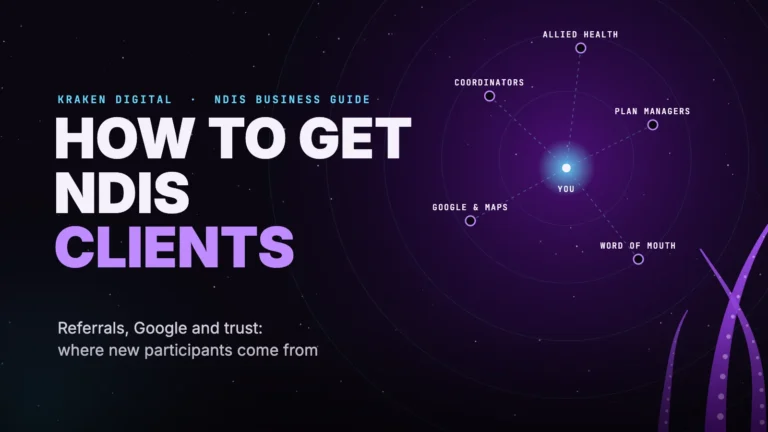
- Referrals are the strongest current. Support coordinators, plan managers and allied health professionals send a large share of new participants. Make referring you easy.
- Trust is the product. Plain language, accessible pages and claims you can back up. Some marketing rules are specific to NDIS and disability.
- Ask every new enquiry how they found you. It’s the cheapest marketing data you’ll ever collect.
Search volumes: Semrush, Australian database, October 2026. Monthly averages, rounded.
What is an NDIS marketing strategy?
An NDIS marketing strategy is a plan for how participants, their families and the professionals around them will find you, understand what you offer, trust you, and get in touch, written down in the order you’ll do it. It is not a social media calendar or a logo refresh. Those are tactics. The strategy decides which tactics matter for your supports, your area and your capacity.
NDIS marketing is different from marketing a café or a trade business in three ways:
- The person choosing often isn’t the participant. It might be a parent, a partner, a support coordinator or a plan manager, and each needs different information.
- The decision is personal and high-stakes. People are inviting you into their home, their routine and sometimes their body. Trust moves slower than in most industries.
- There are extra rules. Consumer law, NDIS logo rules and Google’s advertising policies all treat disability services with more care. More on that in Zone 4.
Here is the whole dive on one page. Each zone builds on the one above it, so resist the urge to skip to the deep end.
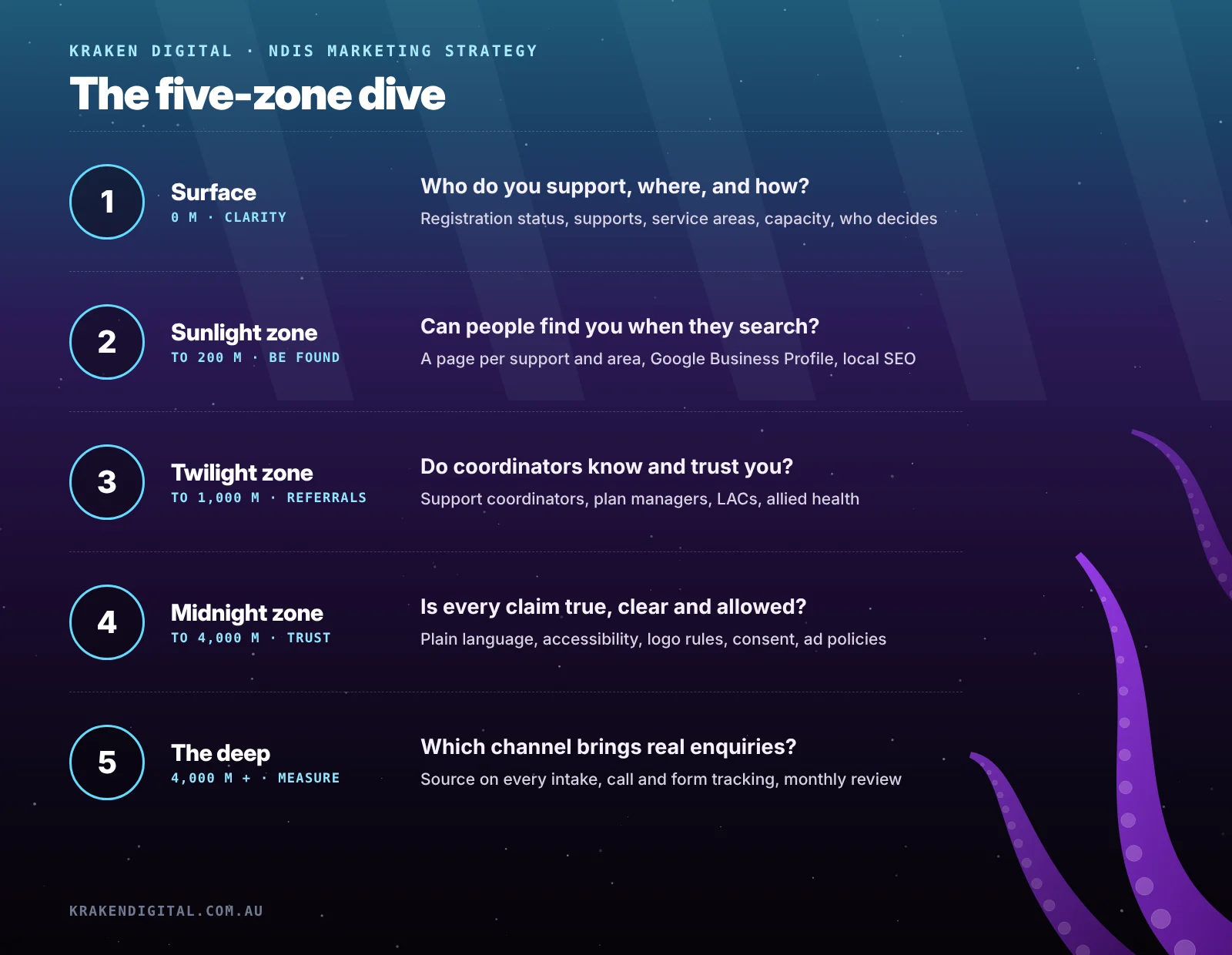
Zone 1, Surface: get clear on who you support
Before anything goes online, write down answers to these. Keep it to one page. It becomes the brief for your website, your Google profile and every conversation with a referrer.
- Your registration status. Registered providers can support participants whose plans are NDIA-managed, self-managed or plan-managed. Unregistered providers can only support self-managed and plan-managed participants. Say which you are, clearly, because coordinators filter on it.
- Your supports, in participants’ words. “Community participation” is the NDIS term; “help getting out to the footy or the shops” is how a family describes it. Use both.
- Who you’re best for. Age group, disability types, cultural background, languages spoken. “Everyone” makes you invisible to the people you’d support best.
- Your service area. Suburbs and regions you actually travel to, not every suburb in the state.
- Your capacity. How many new participants you can take on this quarter. Marketing that brings 30 enquiries when you can onboard five creates waitlists and disappointed families.
Sonar check · 0 m
- Could a stranger explain what you do and where, after reading one sentence about you?
- Have you written down which participants you’re not the right fit for?
- Do you know how many new participants you can take on in the next three months?
Three yeses? You’re ready to descend.
Zone 2, Sunlight: make sure people can find you
The sunlight zone is where most people look first: Google Search and Google Maps. Thousands of Australians search for providers every month, usually with a support and a place in the query, like “NDIS support worker Frankston” or “NDIS OT near me”. To show up:
- Build one page per support. A single “Services” page listing eight supports rarely ranks for any of them. A page for each support, explaining who it’s for, what a session looks like and how funding works, gives Google something specific to show.
- Add pages for the areas you really cover. Write them with local detail (travel times, nearby community spaces, which hospitals or schools you work alongside). Copy-and-paste suburb pages with the name swapped tend to do more harm than good.
- Complete your Google Business Profile. Choose accurate categories, set a service area (you can hide your address if you work from home), add real photos and answer every review. It’s free and it’s what appears in the Maps results.
- Keep your details identical everywhere. Same business name, phone and address on your website, Google profile, Facebook page and directories. If you’re registered, check how your listing appears in the NDIS Provider Finder too.
- Make the site fast and easy to use on a phone. Many participants and carers search on mobile, often with assistive technology. Our NDIS website cost guide covers what a solid build includes, and our NDIS web design page shows how we build them.
What about paid ads? Google Ads can bring enquiries quickly, but it’s worth knowing that Google treats disability as a sensitive health category in its personalised advertising policy. In practice, that means you can’t use Customer Match, your own data segments (remarketing lists) or lookalike audiences for those ads. Keyword and location targeting still work. If you’re a registered charity, check whether you’re eligible for Google for Nonprofits and its Ad Grants program before you spend your own money. Hospitals and healthcare organisations are excluded, so check where your organisation sits.
Sonar check · 200 m
- Search “[your main support] [your suburb]” on your phone. Do you appear on page one or in the map?
- Does each of your main supports have its own page?
- Is your Google Business Profile complete, with photos and replies to reviews?
Zone 3, Twilight: build your referral currents
Below the sunlight, things get quieter and more personal. A large share of new participants don’t come from a search at all. They arrive through someone who already knows the participant: a support coordinator, a plan manager, a Local Area Coordinator, an OT or a family friend. We cover the participant side of this in how NDIS participants find providers online.
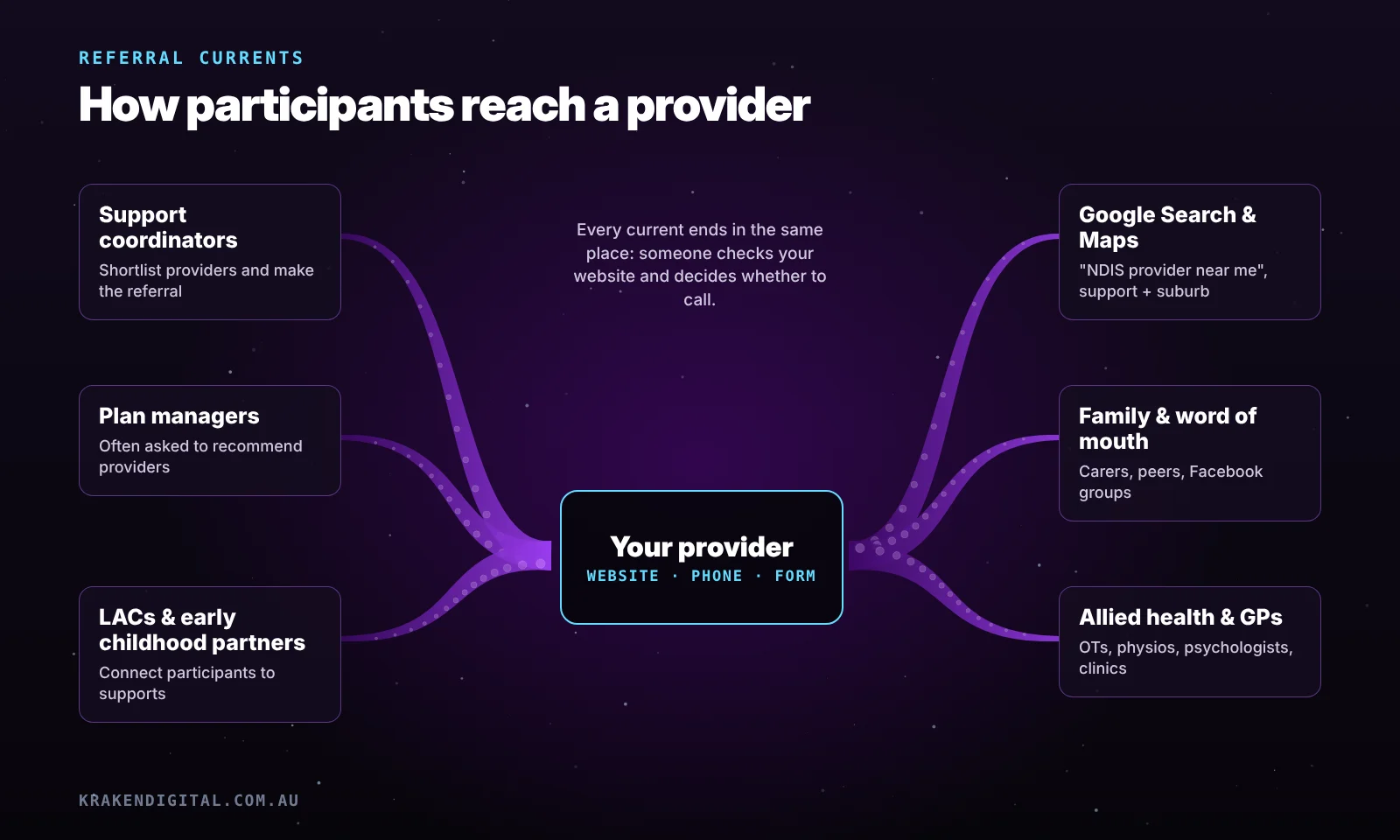
Referrers are busy, and they recommend providers who make their job easier. Give them:
- A one-page referral pack (PDF and web page): supports, areas, registration status, current capacity, languages, and how to refer.
- A simple referral form on your website, with a promised response time you can keep, such as “we reply within one business day”.
- Capacity updates. A short monthly email to referrers: “We have two spots for community participation in the Mornington Peninsula.” It’s the most useful message a coordinator can get.
- A closed loop. Let the referrer know when you’ve made contact (with the participant’s consent). It builds the trust that brings the next referral.
Sonar check · 1,000 m
- Can you name ten referrers who know what you do?
- Can a coordinator refer someone to you in under two minutes?
- Do referrers hear from you when your capacity changes?
Zone 4, Midnight: earn trust and stay within the rules
In the midnight zone there’s no sunlight, so creatures make their own light. For an NDIS provider, that light is trust. It decides whether a family who found you actually picks up the phone. It comes from how you communicate, and from never saying anything you can’t back up.
- Write in plain language. Short sentences, everyday words, NDIS terms explained the first time you use them. Easy Read versions of key pages are a strong signal that you mean it.
- Make your website accessible. Good colour contrast, alt text on images, captions on videos, and forms that work with a keyboard and a screen reader. Our allied health website checklist covers the basics.
- Show real people. Photos of your actual team (with permission), qualifications, and who answers the phone. Stock photos of smiling strangers don’t build trust.
- Get consent for every story. Testimonials, photos and case studies about participants need clear, informed consent, ideally in writing, and the right to withdraw it later.
There are also some NDIS-specific rules worth pinning to the wall:
| Do | Avoid |
|---|---|
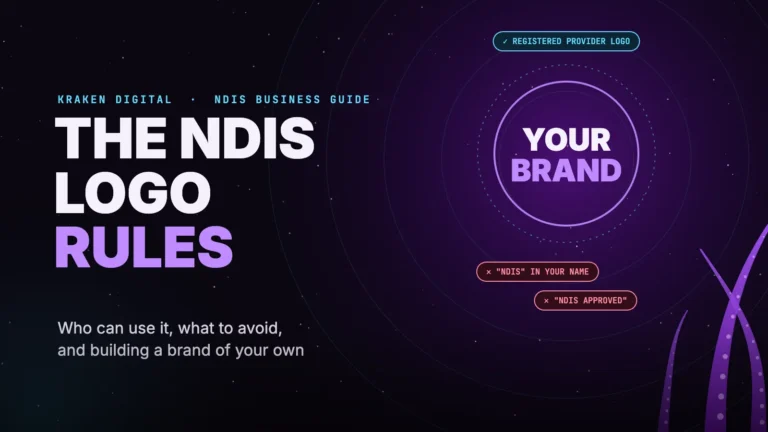
| Use the registered NDIS provider logo only while you’re a registered provider, unchanged, as the NDIA guidelines set out. | Using any NDIS logo if you’re unregistered, or implying registration you don’t have. |
| Describe your services accurately and say clearly if there are costs a plan may not cover. | Calling products or services “NDIS approved”, “NDIS funded” or “endorsed by the NDIA”. The ACCC warns these claims can mislead. |
| Charge participants fair prices in line with what you charge others. | Suggesting participants can always claim an item, or will never pay out of pocket. |
| Target ads by keyword and location. | Ad copy or audiences built on a person’s disability (Google restricts this). |
Sonar check · 4,000 m
- Could a 12-year-old understand your home page?
- Do you have written consent for every participant photo and story online?
- Is every claim on your site something you could prove tomorrow?
Zone 5, The deep: measure what brings enquiries
The deep is where the kraken lives, and where most providers never go: the numbers. Without them, you can’t tell whether the Facebook posts, the coordinator morning tea or the Google profile brought your last five participants. So you keep doing everything, a little, forever.
- Add “How did you hear about us?” to every intake, as a required field with set options (Google, coordinator, plan manager, family or friend, other). Record it in your CRM or a simple spreadsheet.
- Track calls and form submissions in Google Analytics, and check the Insights in your Google Business Profile for calls and direction requests.
- Review monthly, in 30 minutes. Three numbers are enough to start: enquiries, enquiries by source, and enquiries that became participants.
- Own your accounts. Your website, domain, Google profile and analytics should be in your organisation’s name, even if someone else manages them. Here’s what to ask an agency before you sign, and how to tell if a monthly report is real.
Sonar check · 6,000 m
- Do you know where your last ten participants came from?
- Can you log in to your own website, Google profile and analytics today?
- Did you change anything last month based on the numbers?
Your first 90 days
You don’t need to do everything at once. Here’s a realistic order for a small provider with a few hours a week to give it.
| When | Focus | Done looks like |
|---|---|---|
| Weeks 1–2 | Surface | One-page brief: supports, areas, registration, capacity, who you’re best for |
| Weeks 3–6 | Sunlight | Google Business Profile complete; a page for each main support; details consistent everywhere |
| Weeks 5–8 | Twilight | Referral pack and form live; list of ten referrers; first capacity email sent |
| Weeks 7–10 | Midnight | Plain-language and accessibility pass on key pages; consent on file for every story; claims checked |
| Weeks 9–12 | The deep | “How did you hear about us?” on every intake; first 30-minute monthly review done |
Why we write about this: Kraken Digital shares an owner with Good Company Disability Services, an NDIS provider. We’ve made this dive with our own business, including the website that ranked first organically for “NDIS mentor” when we checked from Australia on 12 October 2026. Results vary by location and over time, but the order of the zones has held up.
Free depth check
Want to know which zone your NDIS business is in?
Send us your website and the supports you offer. We’ll check how you show up on Google and Maps, flag anything that could worry a coordinator or a family, and send back a plain-English list of what to do first. No obligation.
NDIS marketing FAQs
What is an NDIS marketing strategy?
It’s a written plan for how participants, families and referrers will find your NDIS business, understand what you offer, trust you and get in touch. It sets the order of the work: get clear on your supports and areas, become findable on Google, build referral relationships, earn trust, then measure what brings enquiries.
How do NDIS providers get new clients?
Mostly through two routes: referrals from support coordinators, plan managers, LACs and allied health professionals, and searches on Google Search and Maps. Word of mouth from families matters too. A strong strategy works on both routes and records where each enquiry came from.
Can unregistered NDIS providers advertise?
Yes. Unregistered providers can market their services to self-managed and plan-managed participants. They shouldn’t use the registered NDIS provider logo or imply they’re registered, and like all providers they must not describe services as “NDIS approved” or make misleading claims.
Can NDIS providers use Google Ads?
Yes, but Google treats disability as a sensitive health category for personalised advertising. You can target by keyword and location, but you can’t use Customer Match, your own data segments (remarketing lists) or lookalike audiences for those ads. Registered charities may be eligible for Google Ad Grants.
Is SEO worth it for an NDIS provider?
For most providers, yes. People search for supports with a suburb in the query, and many of those searches are low competition. Clear pages for each support and area, plus a complete Google Business Profile, often bring enquiries for months after the work is done. Our NDIS SEO page explains how we approach it.
More from the NDIS business guide
This article is one stop in our guide to starting and growing an NDIS business. Keep going:
// keep diving