NDIS Business Plan: The 10 Sections to Include
An NDIS business plan isn’t paperwork for a bank manager. It’s how you check your new disability support business can pay its workers, stay compliant and find enough participants before you commit your savings. This guide gives you the ten sections to include, the questions each one should answer, and where most new providers get the numbers wrong.
We’ve built these plans for our own NDIS business: Kraken Digital shares an owner with Good Company Disability Services.
The short version
- Start narrow. A few supports in a defined area beats “everything, everywhere”.
- Do your pricing from the NDIS price limits down, not from what you’d like to charge.
- Plan cash flow carefully. You pay workers before you are paid for their shifts.
- Treat marketing as a cost line, not an afterthought. Participants don’t arrive on their own.
- Review the plan every quarter against real numbers.
The ten sections of an NDIS business plan
Tap a section to jump to it.
1. Summary
Write this last. In one page, say what supports you’ll provide, to whom, where, how you’re different, and what you need (money, staff, time) to get there.
2. Supports and registration
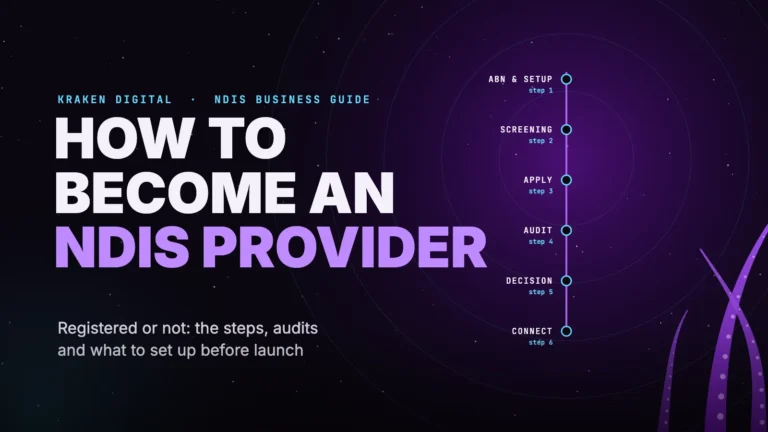
List the supports you’ll deliver and decide whether you’ll register with the NDIS Commission. That decision shapes who you can work with, your audit and your timeline. Our guide on how to become an NDIS provider explains both paths.
3. Participants and service area
Describe the participants you’re best placed to support (age, disability, goals, cultural or language needs) and the suburbs you’ll cover. Note other providers already in that area and the gap you’ll fill. A tight area also keeps travel time, and unpaid kilometres, under control.
4. Pricing
For most supports, the NDIA sets maximum prices in the NDIS Pricing Arrangements and Price Limits, which it reviews each year. Work out your real cost per hour first (wages, super, leave, workers’ compensation, supervision, travel, admin and overheads), then check what margin is left under the price limit. If there isn’t one, change the model before you launch.
5. Cash flow
Workers are paid on a weekly or fortnightly cycle, but you’re paid after you deliver and claim: through the NDIA for NDIA-managed participants, or by the plan manager or participant for the rest. Map when money goes out and comes in for your first 12 months, and hold enough of a buffer to cover a few pay runs.
6. Team
Who does what: key personnel, support workers, rostering, admin and quality. Include NDIS worker screening, training (including the NDIS Worker Orientation Module for registered providers), supervision and how you’ll keep good people.
7. Quality and compliance
Cover the NDIS Code of Conduct (it applies to every provider), the NDIS Practice Standards if you register, your policies and procedures, incident and complaints management, privacy and record keeping, and insurance such as public liability and professional indemnity.
8. Marketing
Set out your name and brand, your website, your Google Business Profile, and your plan for support coordinators and plan managers. Budget for it. Our guides on how to get NDIS clients and the five-zone NDIS marketing strategy give you the steps, and what an NDIS website costs helps with the numbers.
9. Risks
List what could hurt you, such as losing a key worker, a slow first quarter, rule changes or a serious incident, with what you’d do about each one.
10. Targets
Pick a handful of numbers and track them monthly: active participants, hours delivered, enquiries and where they came from, enquiry-to-client rate, worker utilisation, and cash in the bank.
Sonar check · is your plan ready?
- Do you know your true cost per support hour, and the margin under the price limit?
- Could you cover at least a few pay runs if claims were slow?
- Can you name five referrers in your area?
- Have you budgeted for your website and marketing?
- Is your registration decision made and in the timeline?
Common mistakes in NDIS business plans
- Assuming the full price limit is profit, and forgetting leave, super, supervision and travel
- Planning to serve every support type in a large area from day one
- Leaving marketing until after launch, then waiting months for the first referral
- No cash buffer for the gap between paying workers and being paid
- Picking a name with “NDIS” in it, which the NDIA treats as misleading. See NDIS logo rules.
Free depth check
Ready to plan your launch?
Tell us about your NDIS business and where you’ll work. We’ll show you what people search for in your area and how you could show up, so your marketing numbers are based on real data. No obligation.
NDIS business plan: FAQs
What should an NDIS business plan include?
A summary, your supports and registration decision, target participants and service area, pricing against NDIS price limits, cash flow, team, quality and compliance, marketing, risks and targets.
How do I price NDIS services?
For most supports the NDIA sets price limits in the NDIS Pricing Arrangements and Price Limits, reviewed each year. Work out your true cost per hour, including wages, super, leave, travel and overheads, then check the margin under the limit.
Do I need a business plan to register as an NDIS provider?
The NDIS Commission asks for evidence that you can deliver the supports you apply for, plus details of your governance and key personnel. A business plan helps you prepare that and shows the business is viable.
How much money do I need to start an NDIS business?
It depends on your supports, size and registration path. Budget for setup (insurance, software, screening, audit if registering, brand and website) and enough cash to cover several pay runs before claims come in.
Sources
- NDIS: Pricing arrangements and price limits
- NDIS Commission: Apply for registration
- NDIS: Logo guidelines
Checked November 2026. NDIS rules change often, so confirm details with the NDIS Commission before you act.
More from the NDIS business guide
This article is one stop in our guide to starting and growing an NDIS business. Keep going:
- StartHow to become an NDIS provider
- StartNDIS logo rules and branding your business
- Get foundWhat an NDIS website costs
- Get foundHow participants find providers online
- Get foundWebsite checklist for care providers
- Win clientsHow to get NDIS clients
- Win clientsNDIS marketing strategy: a five-zone plan
// keep diving