What Is Domain Authority? DA vs DR vs Authority Score, Explained
Sooner or later, someone will quote you a number. An agency pitch says your website has a “domain authority of 12”. A link seller offers “DA 50+ placements”. A competitor’s report shows a score twice yours. It sounds like a grade Google gives your website. It isn’t.
This guide explains what domain authority actually is, how the three scores you’ll see most often are calculated, why they disagree with each other, what a good score looks like for a small business, how to check yours for free, and how to build the real authority those scores are trying to measure.
The short version
- Domain authority is not a Google metric. It’s a score invented by an SEO software company (Moz) to predict how well a website might rank. Ahrefs (Domain Rating) and Semrush (Authority Score) have their own versions.
- Google doesn’t use any of them. Google has said so repeatedly. But Google does use links, and the scores are mostly built from links, so they’re a useful rough guide.
- The scores are relative and logarithmic. They compare your site with every other site in the tool’s database, and each point is harder to earn than the last.
- There’s no universal “good” score. What matters is how you compare with the businesses you’re competing against in search results.
- Chase the cause, not the number. Relevant links from real local and industry websites, useful content and genuine traffic grow authority. Buying links to lift a score can get you penalised.
What is domain authority?
Domain Authority (DA) is a score from 1 to 100 created by Moz, an SEO software company. Moz describes it as a prediction of how likely a website is to rank in search results compared with other websites. A higher score suggests a stronger, more trusted website, mostly because more (and better) websites link to it.
Two things about the scale matter more than the number itself:
- It’s logarithmic. Moving from 10 to 20 is far easier than moving from 50 to 60. Only the biggest sites on the internet sit in the 90s.
- It’s relative. Your score is calculated against every other site in the tool’s database. If big sites earn lots of new links, your score can drop even though nothing about your website changed.
Because “domain authority” became the everyday name for this kind of score, people use it loosely for the other tools’ versions too. When someone says “DA”, ask which tool they mean. The numbers aren’t interchangeable.
You’ll also see Page Authority (PA), the same idea applied to a single page rather than the whole domain. When people ask “what is DA and PA in SEO?”, that’s the pair they mean.
Does Google use domain authority?
No. Google has been consistent about this for years. Google’s John Mueller has said, among many similar statements, that “Google doesn’t use Domain Authority at all when it comes to Search crawling, indexing, or ranking.” Moz itself says Domain Authority is not a Google ranking factor and has no effect on search results.
That’s only half the story, though, and this is where a lot of articles stop short.
- Links still matter to Google. Google’s own guide to its ranking systems says its link analysis systems, including PageRank, continue to be part of its core ranking systems. Third-party authority scores are attempts to estimate that link strength from the outside.
- Google has site-level signals of its own. In 2020 Mueller acknowledged Google has site-level metrics that “might kind of map into similar things”, while declining to call them authority. In 2024, leaked internal Google documentation referenced an attribute called “siteAuthority”. Google confirmed the documents were real but warned against drawing conclusions from “out-of-context, outdated, or incomplete information”.
The honest summary: Google doesn’t look up your Moz, Ahrefs or Semrush score. But the thing those scores try to measure, how much the rest of the web trusts and references your site, is very much part of how Google ranks pages. Treat the scores like a thermometer, not the weather.
Domain Authority vs Domain Rating vs Authority Score
These are the three scores you’ll see most. They share a 0 to 100 scale and a reliance on links, but they’re built differently.
| Score | Tool | What it’s built from | Worth knowing |
|---|---|---|---|
| Domain Authority (DA) | Moz | Links and linking domains, Moz’s Spam Score and how sites actually rank, combined by a machine-learning model | Logarithmic 1 to 100. Rebuilt in 2019 (“DA 2.0”) to be harder to manipulate. |
| Domain Rating (DR) | Ahrefs | The strength of a site’s backlink profile only | Ignores traffic. A linking site shares its value across every site it links to. |
| Authority Score (AS) | Semrush | Link power, organic traffic and six “natural profile” spam checks | A site with links but no search traffic is held down. Recalculated about every two weeks. |
Moz Domain Authority
Moz crawls the web, counts which domains link to yours and how strong those domains are, then uses a machine-learning model, trained against real Google results, to predict how competitive your site is. Its March 2019 rebuild added its Spam Score and patterns of link manipulation, so a pile of low-quality links counts for much less than it used to.
Ahrefs Domain Rating
Domain Rating is the simplest of the three: it only measures backlinks. Each linking domain passes on some of its own rating, split equally between every site it links to. That has a practical consequence: a link from a small local website that links to only a handful of businesses can move your DR more than a link from a giant directory that links to a million.
Semrush Authority Score
Authority Score is a compound of eight factors in three groups: link power (the number and quality of referring domains), organic traffic (Semrush’s estimate of monthly visits from search), and six natural-profile checks that look for manipulation, such as a site with lots of links but no rankings, or many linking sites sharing the same server. Semrush says the score is best used to compare domains rather than as an absolute grade.
Why your scores disagree
Each company runs its own web crawler, finds a different slice of the internet’s links, weighs them differently and updates on a different schedule. So the same website can easily score 15 in one tool and 30 in another. Neither is wrong; they’re answering slightly different questions.
Here’s a real examp
A common pattern shows why. Picture a new tradie business whose website is a few months old. It already has links from its suppliers, its industry association and a handful of local directories, but it hasn’t started ranking or earning search traffic yet. Ahrefs, which only looks at links, might give it a modest Domain Rating. Semrush, which also weighs organic traffic and holds back sites whose links and traffic don’t line up, could score it in single digits. Nothing is wrong with the site. Each score simply reflects how its tool works, and both should rise as the site earns rankings and visits.
The lesson: always compare like with like. Use one tool, check your competitors in the same tool, and watch the trend over months rather than reacting to a single number.
What is a good domain authority score?
There isn’t a universal good score, and anyone who tells you “you need DA 40” without looking at your market is guessing. A score of 20 is weak if every competitor sits at 45, and strong if they sit at 12. For most local businesses, the competition is other local businesses, not Wikipedia.
A real example: “plumber Melbourne”
Here’s what that looks like in a real search. The screenshot below is Semrush’s analysis of the top ten organic results for “plumber melbourne” in Australia, taken in October 2026. Look at the Domain AS column next to each ranking position.
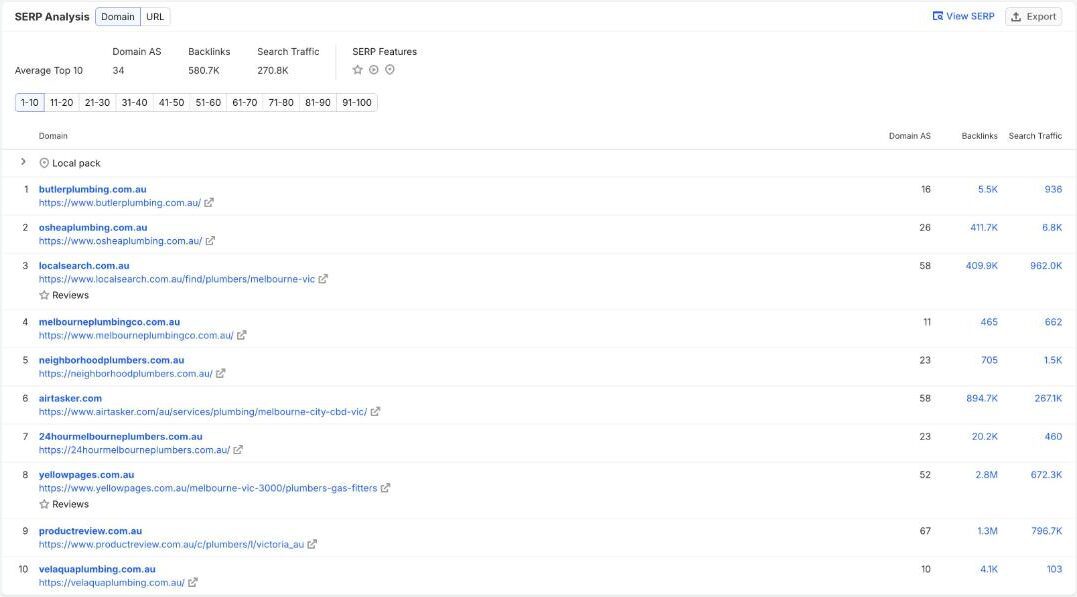
The local plumbing business in first place has an Authority Score of 16. Below it sit a business directory (58), an online marketplace (58), another directory (52) and a review site (67), all with far stronger scores. The average across the top ten is 34, and the first-placed site is well under half of that.
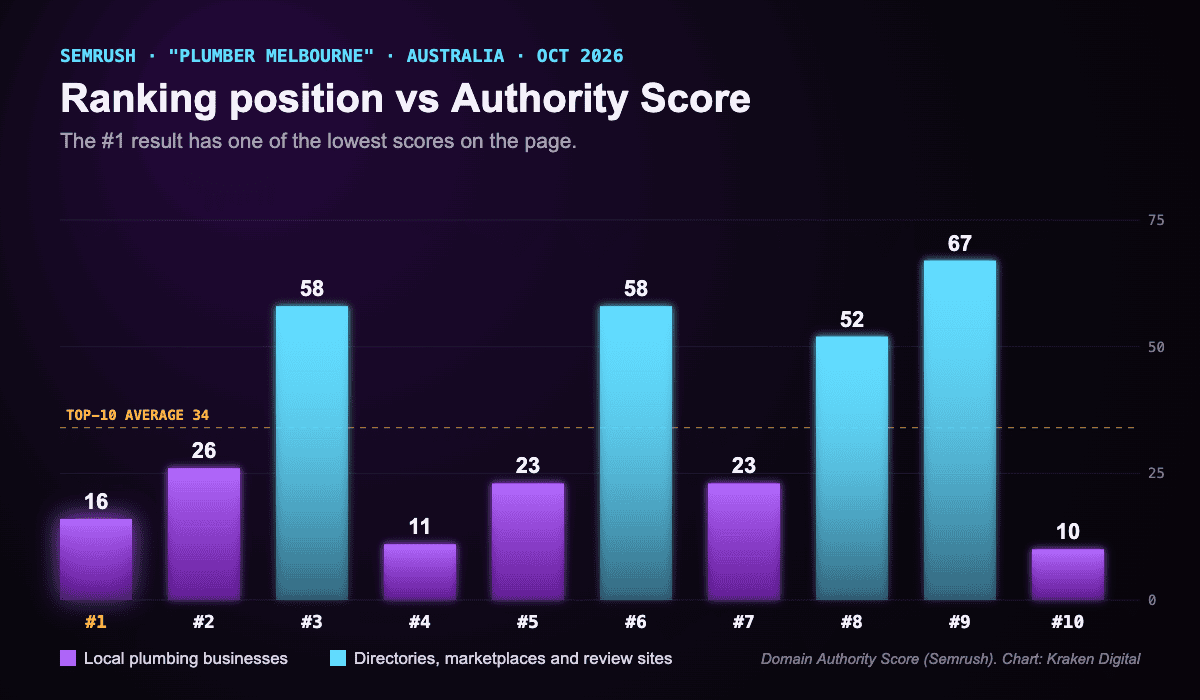
Authority clearly isn’t deciding this search on its own. The top-ranked site wins on relevance: a page built specifically for plumbing in Melbourne, from a business Google can tie to that service and area. That’s the kind of competition most local businesses face, and it’s why your competitors’ scores matter far more than any number on a scale of 100.
Sonar check
Where would your score sit?
Drag the slider to your own Authority Score and see how it compares with the ten sites ranking for “plumber melbourne”.
Here’s how to work out a meaningful target in about ten minutes:
- Search Google for the main thing you want to be found for, for example “plumber Frankston” or “physio Mornington”.
- Note the five businesses ranking organically below the ads and the map pack. Ignore directories and giant brands.
- Check each of their domains in the same tool (see the free options below) and write down the scores.
- Your realistic target is the middle of that range. If your score is already within it, links probably aren’t what’s holding you back; your content, Google Business Profile or website experience are more likely culprits.
How to check your domain authority for free
All three companies offer a limited free check. You’ll need a free account for some of them.
- Moz Domain Authority: Moz’s Link Explorer and free Domain Analysis tool show DA, linking domains and Spam Score.
- Ahrefs Domain Rating: Ahrefs’ free Website Authority Checker shows DR and the number of linking websites.
- Semrush Authority Score: a free Semrush account gives a small number of searches each day, enough to check your site and a few competitors in Domain Overview.
When you check, write down three numbers, not one: the authority score, the number of referring domains (different websites linking to you) and your estimated organic traffic. Referring domains usually tell you more than the score itself, and they’re easier to compare with competitors.
Prefer us to do it? Our free SEO audit includes your authority score, your referring domains and a side-by-side comparison with the competitors you’re up against, explained in plain English.
How to increase domain authority (the right way)
You can’t edit a score directly. You raise it by earning links from websites that are real, relevant and trusted, and by growing genuine search traffic. For a small business, these work best:
- Claim the links you already deserve. Suppliers, manufacturers, franchise or buying groups, industry associations, your local chamber of commerce and business networks often list members or stockists. Ask to be included with a link to your website.
- Turn local relationships into links. Sponsoring a junior sports club, a school fete or a community event usually earns a link from their website, and those local links are exactly the kind Google trusts.
- Find unlinked mentions. Search your business name in quotes. Where a local news story, blog or event page mentions you without linking, a polite email asking for the link often works.
- Publish something worth referencing. A genuinely useful guide, a local price survey, a checklist or original data gives other sites a reason to link. Thin sales pages rarely earn links on their own.
- Contribute expertise. Answer a journalist’s query, write a guest article for an industry publication, or speak at a local event. Each tends to come with a link and a credible mention.
- Fix what you’re leaking. If you’ve changed website or page addresses, old links may point at dead pages. Redirecting them to the right pages recovers authority you’ve already earned. Strong internal linking then spreads it to the pages that matter.
- Grow real search traffic. Semrush factors traffic into its score, and traffic comes from ranking for things people search. Good SEO and content lift both.
- Be consistent with local listings. Business directories and your Google Business Profile won’t move your authority score much, but consistent listings support local SEO, which is usually where local customers find you first.
What not to do
Be wary of anyone selling “high DA backlinks”, guest post packages on sites nobody reads, private blog networks or link swaps. Buying or trading links to manipulate rankings breaks Google’s spam policies, and Google can ignore those links or take action against the site. These schemes often inflate third-party scores precisely because the scores are easier to fool than Google is, which is how businesses end up with a nice number and no new customers.
What matters more than your score
Authority helps you compete, but it rarely decides who gets the call. For local businesses, these usually matter more:
- Relevance: a page that clearly answers what the person searched, for the area they’re in.
- Your Google Business Profile: categories, reviews, photos and activity decide the map pack.
- Website experience: fast, mobile-friendly pages that make it easy to call or enquire.
- Enquiries, not vanity metrics: if an agency reports your domain authority but not your calls and enquiries, that’s a warning sign. Our guide on how to tell if your agency report is real shows what to look for.
Free authority check
What’s your score, and does it actually matter for you?
We’ll check your authority score, referring domains and search traffic, compare them with the businesses ranking above you, and tell you plainly whether links are what’s holding you back. No obligation.
Domain authority FAQs
What is DA in SEO?
DA stands for Domain Authority, a 1 to 100 score created by Moz that predicts how likely a website is to rank compared with other sites. It’s mostly based on links. It’s a third-party estimate, not a Google metric.
What’s the difference between DA and DR?
DA is Moz’s score and combines links, spam signals and real ranking data through a machine-learning model. DR is Ahrefs’ Domain Rating and measures only the strength of a site’s backlink profile. Both run from 0 to 100, but they use different data, so the numbers aren’t comparable.
Is domain authority a Google ranking factor?
No. Google has said many times that it doesn’t use Domain Authority. Google does use links and has its own site-level signals, which is why authority scores loosely track rankings.
How do I check my domain authority for free?
Use Moz’s free Domain Analysis or Link Explorer for DA, Ahrefs’ free Website Authority Checker for DR, or a free Semrush account for Authority Score. Check your competitors in the same tool so you’re comparing like with like.
What is a good domain authority for a small business?
One that’s in line with the businesses ranking for your main searches. Check the top five organic results for your key search in one tool and aim for the middle of their range. It is common for successful local businesses to score well under 30.
How long does it take to increase domain authority?
Usually months. Tools need to discover new links before scores update (Semrush recalculates about every two weeks), and because the scales are logarithmic, each point takes more than the last. Focus on steady, relevant links and growing traffic rather than quick jumps.
Why did my domain authority drop?
Often nothing happened to your site. Scores are relative, so they can fall when other sites gain links or when a tool updates its model. Lost links, a site migration without redirects, or (in Semrush) falling organic traffic can also lower it.
Sources
- Google Search Central, A guide to Google Search ranking systems
- Google Search Central, Spam policies for Google web search
- Search Engine Journal, Domain Authority: is it a Google ranking factor?
- Ahrefs Help, What is Ahrefs Domain Rating and how is it calculated?
- Semrush Knowledge Base, Authority Score
- Wikipedia, 2024 Google Search documentation leak
// keep diving